
-

Phase One: Information Gathering
This first step is actually the most important one, as it involves a solid understanding of your company, what your business goals are, and how the web can be utilized to help you achieve those goals.
It is important that we start off by asking a lot of questions to help us understand your business and your needs in a web application.
Certain things to consider are:
- Purpose
What is the purpose of the web application? - Goals
What do you hope to accomplish by building this web application? Two of the more common goals are either to make a complicated process easier or take a manual process and automate it.
- Purpose
-
Phase Two: Planning
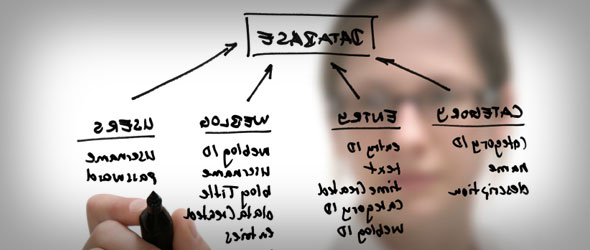
Using the information gathered from phase one, it is time to put together a plan for your web application. This is the point where a site map and wire-frames are developed.
The site map is a list of all of the functional areas of the application, as well as the sub-functions, if applicable. This serves as a guide as to what content will be in the application, and is essential to developing a consistent, easy to understand navigational system. The end-user (you) must be kept in mind when designing your application. You are, after all, the people who will be using the application day-to-day. A good user interface creates an easy to navigate web application, and highlights the importance of having a good plan in place.
During the planning phase, we will also help you decide what technologies should be implemented. We will discuss what current systems will need to integrate with the new software and what security protocals should be in place to insure a safe, productive environment.
-

Phase Three: Design
Drawing from the information gathered up to this point, it’s time to determine the look and feel of your web application.
In the design phase we will create a functional prototype for your application. This is typically a "click-through" version of what the final design will look like. Often times you will be sent an email with access to a secure area of your application. This also allows you to view our work in progress. The most important reason for this is that it gives you the opportunity to express your likes and dislikes on the application design before we begin any coding.
In this phase, communication between both you and the designer is crucial to ensure that the final web application will match your needs and taste. It is important that you work closely with your designer, exchanging ideas, until you arrive at the final design for your application.
Then development can begin…
-

Phase Four: Development
The developmental stage is the point where the web application itself is created. At this time, your web designer will take all of the individual graphic elements from the prototype and use them to create the actual, functional application.
Elements such as the CMS (content management system), interactive forms, or ecommerce shopping carts (or other financial systems) are implemented and made functional during this phase, as well. This entire time, your designer should continue to make your in-progress web site available to you for viewing, so that you can suggest any additional changes or corrections you would like to have done.
On the technical front, a successful web application requires an understanding of front-end and back-end web development. This involves writing valid HTML / CSS code that complies to current web standards, maximizing functionality, as well as building a robust core framework that will be scalable as well as easily modified in the future.
This is tested in the next phase…
-
Phase Five: Testing and Delivery
At this point, your web designer will attend to the final details and test your web application. We will test things such as the complete functionality of forms or other scripts, as well last testing for compatibility issues (viewing differences between different web browsers), ensuring that your web site is optimized to be viewed properly in the most recent browser versions.
A good web designer is one who is well versed in current standards for web site design and development. The basic technologies currently used are HTML and CSS (Cascading Style Sheets). As part of testing, your designer will check to be sure that all of the code written for your web site validates. Valid code means that your site meets the current web development standards – this is helpful when checking for issues such as cross-browser compatibility as mentioned above.
Once you give your web designer final approval, it is time to deliver the application to your users. An FTP (File Transfer Protocol) program is used to upload the web site files to your server. We can also host your web application if you would like. We will then setup the initial user accounts. Once these accounts have been setup, and your web site uploaded to the server, the site will be put through one last run-through. This is just precautionary, to confirm that all files have been uploaded correctly, and that the application continues to be fully functional.
This marks the official launch of your application, as it is now viewable to your users.
-

Phase Six: Maintenance
The delivery of your web application is not necessarily the last step. We will be more than happy to continue working together with you, to update the functionality of your web application. Over time, users may suggest new ways to improve productivity and increase the usability of your web application. Our software is built to make improvements easy to incorporate without heavy costs or long timelines.
Our software also gives you the ability to edit the content areas of the web application yourself. You are given access to a back-end administrative area, where you can use an online text editor (similar to a mini version of Microsoft Word). You’ll be able to edit existing content this way. That’s where the help of a your web designer comes in, once again, as they can take over the web site maintenance for you – one less thing for you to do is always a good thing in these busy times!
Other maintenance type items include regular site backups, technology upgrades, additional plugin installation, etc.
About Us
ElonTech is a Texas-based web application design firm specializing in Microsoft .NET development that combines industry-leading web application design expertise with proven business acumen to transform the way our clients do business.
Our Markets

-
Medical: We help hospital systems of all sizes analyze patient needs, costs, and compliance requirements to build a solid technology solution.

-
Government: We provide superior expertise tailored for government needs with easy to use procurement channels to quickly source your IT services.
Contact Us
Email: support@elontech.com
Stay Connected
2025 © Elon Technologies, Inc. ALL Rights Reserved.